
Template Website vs Custom Website: Which Is the Better Investment for Business Growth, SEO & AI Search?
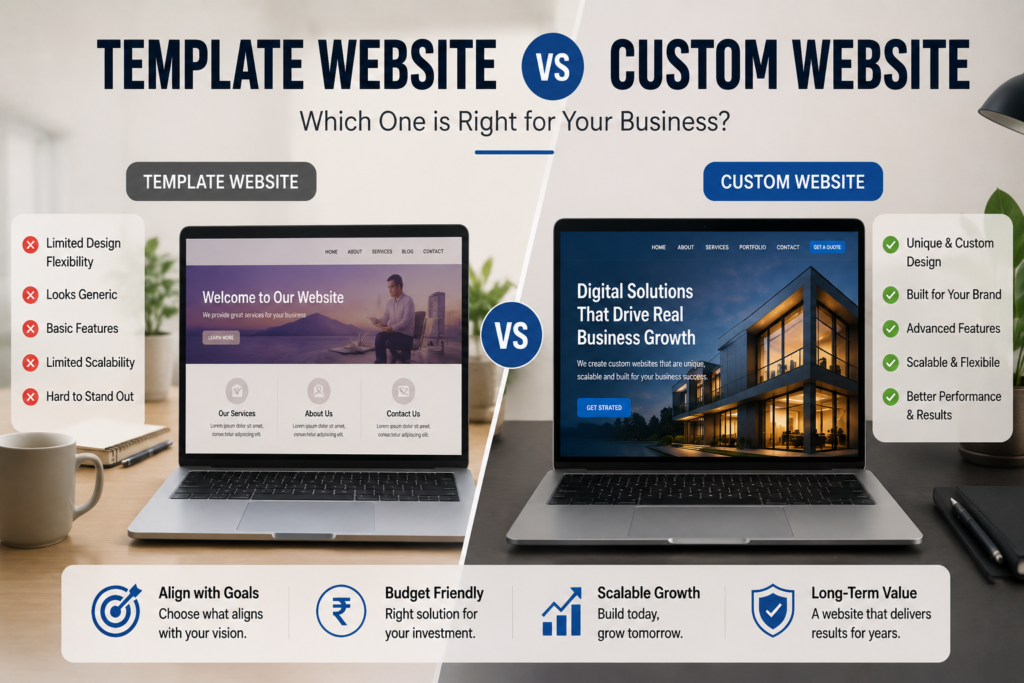
Every Great Business Starts with a Vision. Your Website Should Too.
Imagine you’re planning to build your dream home.
You have two options.
The first is to purchase a ready-made house built for someone else’s lifestyle. It may look attractive, cost less initially, and allow you to move in quickly. However, you have little control over the layout, future expansion, or how well it fits your family’s unique needs.
The second option is to work with an architect who designs every room, every space, and every detail around your lifestyle, preferences, and long-term plans. While this approach requires more planning, the result is a home built specifically for you—one that can adapt as your family and needs evolve.
Choosing a website for your business is remarkably similar.
At first glance, a template website and a custom website may appear to achieve the same objective. Both can showcase your business, display your services, and provide contact information.
However, the real question isn’t whether both options can create a website.
The real question is:
Which website will continue supporting your business as your customers, marketing strategy, technology, and growth ambitions evolve over the next three to five years?
That is where the difference begins.
In today’s digital world, a website is no longer just an online presence. It has become one of the most valuable business assets a company can own.
Your website represents your brand, builds trust, attracts potential customers, supports your digital marketing campaigns, improves search visibility, and helps convert visitors into enquiries and sales—all while working for your business 24 hours a day.
The importance of this decision has grown even further with the rise of AI-powered search experiences such as Google AI Overviews, ChatGPT, Gemini, Perplexity, and other intelligent search platforms. Modern businesses need websites that are not only visually appealing but also strategically planned, technically optimized, and ready to meet the expectations of both users and search engines.
This is why choosing between a template website and a custom website is no longer just a design decision.
It is a business decision.
Throughout this guide, we’ll compare both approaches from a business perspective—not just by looking at design or development, but by evaluating how each option influences branding, customer trust, SEO, AI search visibility, website performance, scalability, lead generation, and long-term business growth.
Because at the end of the day, the best website isn’t necessarily the one that’s built the fastest or costs the least.
It’s the one that helps your business grow.
Why Choosing the Right Website Matters More Than Ever
If you’re investing in a website, you’re not simply buying a digital product.
You’re investing in how your business will be perceived, discovered, and remembered online.
Think about your own buying behaviour.
When you’re looking for a hotel, restaurant, clinic, real estate company, or any professional service, what’s one of the first things you do?
You visit their website.
Within just a few moments, you begin asking yourself questions like:
- Does this business look professional?
- Can I trust this company?
- Are their services genuine?
- Will they deliver quality work?
- Should I contact them or continue searching?
Your customers go through the exact same thought process.
Long before they speak to your sales team, call your office, or send an enquiry, your website has already started selling your business—or losing potential customers.
That’s why a website should never be viewed as just another business expense.
It should be treated as one of your most valuable business investments.
- Build trust from the very first visit.
- Strengthen your brand identity.
- Generate qualified enquiries.
- Improve your visibility on Google and AI-powered search platforms.
- Support your SEO, digital marketing, and advertising campaigns.
- Create a better customer experience.
- Grow alongside your business for years to come.
On the other hand, a website built only to get online quickly may not always provide the flexibility, performance, or strategic foundation needed as your business expands.
The real challenge isn’t launching a website.
The real challenge is building one that continues creating value as your business grows.
That’s exactly why choosing between a template website and a custom website deserves careful consideration.
Because the decision you make today can influence your marketing performance, customer trust, online visibility, and business growth for years to come.
Why Many Businesses Start with a Template Website
When launching a new business or creating a website for the first time, it’s natural to look for a solution that appears simple, affordable, and quick to implement.
This is one of the main reasons many businesses explore template-based websites.
From the outside, the decision seems logical.
If a professionally designed template can help your business go online quickly, why spend additional time and resources building a custom website?
It’s a question worth asking.
After all, every business wants to make smart financial decisions.
However, before making that decision, it’s important to understand one thing:
Choosing a website isn’t simply about launching today. It’s about supporting your business tomorrow.
A website isn’t a one-time purchase that remains unchanged forever.
As your business grows, your website is expected to grow with it.
Your services evolve.
Your customers’ expectations change.
Your competitors improve.
Search engines introduce new ranking factors.
AI-powered search continues to reshape how businesses are discovered online.
Your marketing strategy expands.
The question every business owner should ask isn’t:
“Will a template website help me launch?”
Instead, ask yourself:
“Will the website I choose today continue supporting my business as it grows over the next three to five years?”
That single question often changes the way businesses evaluate their website investment.
Because while launching quickly can feel like progress, building a website that continues delivering value for years is what truly supports long-term business growth.
Business Insight
Many businesses don’t replace their website because it looks outdated.
They replace it because it no longer supports their business goals.
By the time that realization happens, the cost of redesigning, migrating content, improving SEO, and rebuilding customer trust can be significantly higher than planning the website strategically from the beginning.
Think Beyond Launch Day
A website should never be judged only by how quickly it can be published.
It should be evaluated by questions such as:
- Will this website strengthen my brand as my business grows?
- Will it support future SEO strategies?
- Will it be ready for AI-powered search experiences?
- Will it allow me to introduce new services without major redevelopment?
- Will it continue delivering an excellent customer experience as technology evolves?
- Will it support my digital marketing investment over the coming years?
If the answer to these questions is uncertain, it’s worth taking a step back before making a decision.
Because the website you build today will influence your online success long after launch day.
A Better Way to Think About Your Website
Rather than asking:
“Which website can I build the fastest?”
Consider asking:
“Which website will still be helping my business grow five years from now?”
That shift in thinking transforms a website from a short-term expense into a long-term business investment.
And that’s exactly how successful businesses approach digital growth.
When Does a Template Website Become a Business Limitation?
Every business starts somewhere.
What works for your business today may not be enough six months, two years, or five years from now.
The same principle applies to your website.
A website shouldn’t only support your business on launch day—it should continue supporting your growth as your business evolves.
This is where many businesses begin to experience the difference between choosing a website for today’s requirements and choosing one for tomorrow’s opportunities.
As your business grows, your expectations naturally grow with it.
You may want to:
- Launch new services or products.
- Expand into new cities or markets.
- Improve your visibility on Google.
- Rank in AI-powered search platforms.
- Generate more qualified enquiries.
- Integrate booking systems, CRMs, payment gateways, or marketing tools.
- Create landing pages for advertising campaigns.
- Improve website speed and user experience.
- Strengthen your brand identity.
- Track customer behaviour and improve conversions.
These aren’t unusual requests.
They’re signs that your business is moving forward.
The important question is:
Will your website be able to support those ambitions without holding your business back?
That question matters far more than how quickly the website was launched.
Business Growth Changes Everything
Many businesses initially focus on getting online.
As they grow, their priorities change.
Instead of simply having a website, they begin asking questions like:
- Why isn’t my website generating enough enquiries?
- Why are visitors leaving without contacting us?
- Why isn’t our website ranking for important keywords?
- Can we integrate new business tools?
- Can we improve the customer experience?
- Can we scale our marketing campaigns without redesigning the website?
These questions usually don’t appear on day one.
They appear when the business begins growing.
That’s why experienced business owners often evaluate a website not only by what it can do today—but by what it will allow them to achieve tomorrow.
Your Website Should Grow With Your Business
Imagine opening a second branch.
Launching a new service.
Expanding internationally.
Adding online bookings.
Introducing multilingual content.
Running Google Ads.
Investing in SEO.
Optimizing for AI-powered search.
Your website should make these opportunities easier—not more complicated.
When your website is planned with long-term business objectives in mind, adapting to change becomes part of the strategy rather than an unexpected challenge.
Because business growth should create new opportunities—not new limitations.
Business Insight
A successful business rarely stands still.
Your website shouldn’t either.
The businesses that achieve sustainable digital growth often choose solutions that provide flexibility, room for improvement, and the ability to adapt as customer expectations and technology continue to evolve.
Planning for tomorrow is often more valuable than solving only today’s requirements.
Before Making Your Decision
Rather than asking:
“Will this website meet my current needs?”
Consider asking:
- Will this website support my business three years from now?
- Will it adapt as technology changes?
- Will it strengthen my marketing efforts?
- Will it help me compete in an increasingly digital marketplace?
- Will it continue creating value without requiring a complete rebuild?
The answers to these questions can have a much greater impact on your business than the initial development cost alone.
💡 Jainexa Business Insight
One of the biggest misconceptions in website development is believing that launching a website is the finish line.
In reality, it’s only the starting point.
The real value of a website is measured by what it helps your business achieve after it goes live—whether that’s attracting more visitors, generating qualified leads, strengthening your brand, improving customer experience, or supporting long-term business growth.
That’s why a website should never be planned only for launch day.
It should be planned for the future of your business.
Why Do Growing Businesses Choose Custom Website Development?
Every successful business reaches a point where growth demands more than standard solutions.
Whether it’s expanding into new markets, launching new services, improving customer experience, or increasing online visibility, growing businesses eventually need systems that are designed around their business goals—not someone else’s template.
The same applies to your website.
A custom website isn’t simply about creating a unique design.
It’s about building a digital platform that reflects your brand, supports your marketing strategy, adapts to your business processes, and grows alongside your company.
Instead of asking:
“What can this website do?”
Growing businesses ask:
“What do we want our website to achieve?”
That shift in thinking changes everything.
A Website Should Reflect How Your Business Works
Every business belongs to an industry.
But no two businesses operate in exactly the same way.
Two hotels may offer accommodation, yet they target different guests, provide different experiences, have different pricing strategies, and follow different marketing objectives.
Two restaurants may serve similar cuisines, but one focuses on online reservations while another relies on walk-in customers and food delivery.
Two real estate companies may sell properties in the same city, but each has different services, customer journeys, and sales processes.
The same applies to almost every business.
Your website shouldn’t only represent your industry.
It should represent your business.
That’s where strategic website planning begins.
Before a single page is designed or a single line of code is written, it’s important to understand questions such as:
- Who are your ideal customers?
- What problems are they trying to solve?
- Why should they choose your business instead of a competitor?
- What action do you want them to take when they visit your website?
- Which pages are most likely to influence their buying decision?
- How will your website support your sales and marketing strategy over the next few years?
The answers to these questions shape a website that is built around your business objectives—not just your industry category.
That’s why successful businesses don’t simply ask for a website.
They invest in a website strategy.
Template Website vs Custom Website: A Business Perspective
By now, you’ve probably realized that choosing a website isn’t simply about selecting a design.
It’s about choosing a foundation that will support your business, marketing efforts, and customer experience for years to come.
The question is no longer:
“Which website looks better?”
The better question is:
“Which website will create more value for my business over the long term?”
To answer that, let’s compare both approaches from the perspective that matters most—business growth.
1. Your Brand Identity
Your website is often the first interaction people have with your business. Before customers call you, visit your office, or request a quotation, they form an opinion based on what they see online. A professionally planned website doesn't just display your logo and company information. It communicates your values, professionalism, and credibility. Many template-based websites offer attractive designs, but they often begin with the same visual framework used by many other businesses. While colours, images, and text can be customised, creating a truly distinctive digital identity may require additional planning and development. A strategically planned website starts with a different question: "How should customers remember our brand?" That question influences every design decision—from page layouts and navigation to messaging, imagery, and user experience. Business Insight Your competitors can offer similar services. Your brand is what helps customers remember you.
2. Flexibility as Your Business Grows
Every growing business changes. You may introduce new services, expand into new locations, launch marketing campaigns, or adopt new technologies. The question is: Will your website make those changes easier—or more complicated? A website designed with future growth in mind provides greater flexibility when new requirements arise. Rather than rebuilding significant parts of the website, many improvements can be planned as part of an ongoing growth strategy. Business Insight Businesses rarely regret planning for growth. They often regret planning only for today's requirements.
3. Marketing Without Limitations
A website shouldn't simply exist online. It should actively support your marketing efforts. Think about everything your marketing team may want to do over the next few years: Create landing pages for advertising campaigns. Capture qualified leads. Improve conversion rates. Test different calls-to-action. Connect CRM systems. Track customer behaviour. Improve user journeys. Launch seasonal campaigns. The more adaptable your website is, the easier it becomes to implement these strategies without disrupting your business
Business Insight
Your marketing strategy will evolve.
Your website should be ready to evolve with it.
4. Long-Term Business Value
Many business owners naturally compare website options based on their initial investment. While that's understandable, it's equally important to consider the value your website creates over time. A website that supports lead generation, strengthens your brand, improves search visibility, and adapts as your business grows often delivers value far beyond its launch. Instead of asking: "What will this website cost me today?" Consider asking: "What opportunities could this website create for my business over the next five years?" That single shift in perspective often leads to a more strategic decision.
Business Takeaway
The difference between a template website and a strategically planned website isn’t simply how they’re built.
It’s how effectively they support your business as it grows.
The most successful businesses don’t invest in websites because they need pages.
They invest because they need a digital platform that helps them attract customers, strengthen their brand, and create long-term business value.
Template Website vs Custom Website: The Complete Business Comparison
Every business has unique goals, challenges, and growth plans. That’s why choosing a website shouldn’t be based solely on design, development time, or initial investment.
A website plays a much bigger role than simply creating an online presence. It influences how customers perceive your brand, how easily they find your business, how confidently they engage with your services, and how effectively your digital marketing efforts perform over time.
When comparing a template website and a custom website, the objective isn’t to decide which one is universally better. The objective is to understand which approach is better suited to your business goals, marketing strategy, and long-term vision.
The comparison below examines both approaches from a business perspective, highlighting the factors that can influence your website’s performance, flexibility, and long-term value.
How Your Website Can Influence SEO, AI Search & Online Visibility
Building a professional website is an important milestone, but it’s only the beginning of your digital journey.
A website delivers its greatest value when it helps potential customers discover your business at the exact moment they’re searching for the products or services you offer.
Think about how people search today.
A few years ago, someone might have searched:
“Website Design Company in India”
Today, they are just as likely to ask:
“Which type of website is better for long-term business growth?”
or
“How do I choose the right website development company?”
Search behaviour is changing.
Customers are asking more detailed questions, expecting more accurate answers, and relying on multiple platforms to research businesses before making a decision.
That’s why modern websites need to do more than look professional.
They need to communicate clearly with both people and search engines.
A Website That Can't Be Found Can't Generate Business
Imagine opening a beautifully designed showroom in the middle of a city but placing no signboards, no directions, and no information to help customers find it.
No matter how impressive the showroom is, very few people will discover it.
Your website works in much the same way.
Without proper optimization, valuable content, and a clear structure, even an excellent website may struggle to reach the audience it was built to serve.
That’s why SEO should never be treated as an afterthought.
It should be considered during the planning stage of your website.
SEO Is More Than Just Keywords
Many business owners associate SEO with adding keywords to a webpage.
While keywords remain important, modern SEO is much broader.
Search engines evaluate hundreds of signals to determine whether a website deserves visibility.
Some of the most important include:
- Helpful and original content
- Clear website structure
- Mobile-friendly design
- Fast loading speed
- Easy navigation
- Internal linking
- Technical optimization
- Positive user experience
These elements work together to help search engines understand your website while making it easier for customers to find the information they need.
AI Search Is Changing the Way Customers Discover Businesses
Artificial intelligence is transforming online search.
Platforms such as Google AI Overviews, ChatGPT, Gemini, and Perplexity increasingly provide direct answers by analysing reliable and well-structured information from across the web.
This means businesses should think beyond traditional search rankings.
Publishing clear, accurate, and genuinely helpful content helps establish your website as a trusted source of information—not only for potential customers but also for emerging AI-powered search experiences.
Rather than writing content only for algorithms, businesses should focus on answering real customer questions with clarity and expertise.
Business Insight
A well-designed website may create a great first impression.
A well-optimized website creates opportunities for customers to discover that first impression.
The strongest digital strategies combine both.
How to Choose the Right Website for Your Business
There’s no single answer that fits every business.
The right website isn’t determined by what’s trending, what your competitors are using, or what costs the least. It’s determined by how well your website supports your business objectives, your customers, and your long-term digital strategy.
Before making a decision, take a step back and evaluate what you expect your website to achieve—not just on launch day, but over the coming years.
The following questions can help you make a more informed decision.
1. What Is the Primary Purpose of Your Website?
Start by identifying what success looks like for your business.
Ask yourself:
- Is my website only meant to provide business information?
- Do I want to generate enquiries and qualified leads?
- Will customers book appointments or purchase products online?
- Will my website support my sales team?
- Do I plan to invest in digital marketing and SEO?
The clearer your objectives, the easier it becomes to choose the right website approach.
2. How Important Is Your Brand Identity?
Your website is often the first interaction customers have with your business.
Consider whether you want your website to:
- Reflect your brand personality.
- Differentiate you from competitors.
- Build credibility and trust.
- Create a memorable first impression.
If branding plays an important role in your business strategy, your website should support that objective from the beginning.
3. Are You Planning to Invest in Digital Marketing?
A website and digital marketing should never be planned separately.
If you intend to invest in:
- Search Engine Optimization (SEO)
- Google Ads
- Social Media Marketing
- Email Marketing
- Content Marketing
- Local SEO
- AI Search Optimization
your website should be prepared to support these activities effectively.
Planning ahead can save time, reduce future redevelopment, and create a better foundation for long-term marketing success.
4. Can Your Website Adapt as Your Business Evolves?
Business requirements rarely remain the same.
You may decide to:
- Introduce new services.
- Expand into new locations.
- Launch seasonal campaigns.
- Integrate third-party tools.
- Improve customer experience.
- Add multilingual content.
Choosing a website that can adapt to these changes makes future improvements easier and helps your digital presence evolve alongside your business.
5. Think Beyond the Launch
Launching a website is an important milestone—but it’s only the beginning.
The real value of a website is measured by what it helps your business achieve after it goes live.
A successful website should continue to:
- Attract potential customers.
- Build trust.
- Support marketing campaigns.
- Strengthen your brand.
- Generate enquiries.
- Create new business opportunities.
When evaluating your options, consider not only the initial investment but also the value your website can deliver over time.
Business Checklist Before Making Your Decision
Before choosing a website approach, ask yourself:
✔ Does this website align with my business goals?
✔ Will it support my marketing strategy?
✔ Can it grow as my business grows?
✔ Will it create a positive customer experience?
✔ Is it prepared for SEO and AI-powered search?
✔ Does it represent my brand professionally?
If you can confidently answer “Yes” to these questions, you’re far more likely to invest in a website that continues creating value long after it’s launched
Business Insight
The best website isn’t always the one with the most features.
It’s the one that helps your business achieve its goals more effectively.
That’s why choosing a website should never be based on price or appearance alone.
It should be based on how well it supports the future you want to build.
Before You Hire a Website Development Company: 10 Questions Every Business Owner Should Ask
Choosing a website development company is an important business decision.
Your website represents your brand, supports your marketing efforts, and often becomes the first point of interaction between your business and potential customers.
That’s why evaluating a website development company should go beyond comparing quotations or delivery timelines.
Before making your decision, take time to ask the right questions. The answers will help you understand not only what the agency will build, but also how they approach your business objectives.
1. Do They Take Time to Understand Your Business?
A professional website should be built around your business—not just your industry.
Ask whether the agency takes time to understand:
- Your business goals
- Your target audience
- Your services
- Your competitive advantages
- Your long-term vision
A website developed without understanding your business is unlikely to reflect your brand effectively.
2. Will the Website Be Planned with SEO in Mind?
SEO shouldn’t begin after your website is launched.
It should be considered during planning.
Ask questions such as:
- Will the website have an SEO-friendly structure?
- Will page URLs follow best practices?
- Will headings be organized correctly?
- Will technical SEO be considered from the beginning?
- Will image optimization and internal linking be included?
Planning for SEO early often saves time and reduces the need for significant changes later.
3. How Will the Website Support Future Growth?
Business needs evolve.
Ask how the website can accommodate future changes such as:
- New services
- Additional locations
- Marketing campaigns
- Third-party integrations
- Customer portals
- Online booking systems
- E-commerce features
A website should support future opportunities rather than requiring a complete rebuild whenever your business expands.
4. Who Will Own the Website After Completion?
This is one of the most overlooked questions.
Before signing any agreement, clarify:
- Will you own the website?
- Will you have full administrator access?
- Will you own the domain name?
- Will you control your hosting account?
- Will you receive all website files and credentials?
Your website is a business asset. Ownership and access should always be transparent.
5. What Happens After the Website Is Launched?
Launching a website is only the beginning.
Ask whether the agency provides:
- Website maintenance
- Security updates
- Performance monitoring
- Backup management
- Technical support
- Content updates
Understanding post-launch support helps you plan for the long-term success of your website.
6. How Will Website Performance Be Optimized?
Website speed directly influences user experience.
Ask how the agency plans to improve:
- Page loading speed
- Mobile responsiveness
- Image optimization
- Caching
- Core Web Vitals
- Overall performance
A fast website creates a better experience for visitors and supports your digital marketing efforts.
7. Will the Website Be Easy to Manage?
Your website should work for you—not create unnecessary complexity.
Find out:
- Can you update text and images yourself?
- Will training be provided?
- Is the content management system user-friendly?
- Can new pages be added easily in the future?
A website should empower your team to manage day-to-day updates with confidence.
8. How Will Success Be Measured?
A professional agency should discuss outcomes—not just deliverables.
Ask how success will be measured after launch.
For example:
- Website enquiries
- Lead generation
- Organic traffic
- Conversion rate
- User engagement
- Search visibility
Clear objectives help ensure the website supports measurable business results.
9. Can They Show Relevant Experience?
Ask to review examples of previous work.
Look beyond visual design and understand:
- The industries they have worked with.
- The business challenges they helped solve.
- The results their websites have achieved.
- Their approach to planning and execution.
Experience becomes more meaningful when it demonstrates problem-solving rather than simply displaying attractive designs.
10. Do They Focus on Building Websites—or Growing Businesses?
Perhaps the most important question of all.
Some agencies focus primarily on delivering a completed website.
Others take a broader approach by considering branding, SEO, user experience, content strategy, digital marketing, and long-term business objectives.
The difference isn’t just in the website they deliver.
It’s in the value that website creates after launch.
Business Owner's Website Selection Checklist
Before making your final decision, ask yourself:
✅ Does the agency understand my business goals?
✅ Will the website support my marketing strategy?
✅ Is SEO considered from the planning stage?
✅ Can the website evolve as my business grows?
✅ Will I own and control my website?
✅ Is there a clear maintenance and support plan?
✅ Does the agency measure success beyond simply launching the website?
If most of your answers are “Yes,” you’re more likely to invest in a website that delivers lasting value rather than simply meeting short-term requirements.
Business Insight
The best website development companies don’t begin by asking,
“What kind of website do you want?”
They begin by asking,
“What do you want your business to achieve?”
That single question often determines whether a website becomes just another online presence—or a valuable business asset that supports your brand, attracts customers, and contributes to long-term success.
Conclusion: Build a Website That Supports Your Business Vision
Choosing between a template website and a custom website isn’t about identifying a universal winner. It’s about selecting the approach that best aligns with your business goals, customer expectations, and long-term digital strategy.
For some businesses, a professionally implemented template website may provide the functionality they need today. For others, investing in a custom website offers the flexibility to support branding, digital marketing, customer engagement, and future expansion.
The right decision depends on understanding not only where your business stands today, but also where you want it to be tomorrow.
As technology continues to evolve, customer expectations are changing alongside it. Search engines are becoming more intelligent, AI-powered search platforms are transforming how people discover businesses, and online competition continues to increase across every industry.
In this environment, a website should do more than establish an online presence. It should communicate your brand effectively, deliver a seamless user experience, support your marketing strategy, and create opportunities for meaningful business growth.
Whether you choose a template website or a custom-built solution, focus on building a website that delivers value—not only on the day it launches, but throughout its entire lifecycle.
A thoughtfully planned website is more than a business expense.
It’s an investment in your brand, your customer experience, and your digital future.
Final Business Insight
Your website is often the first conversation a customer has with your business.
Before they call you, visit your office, or request a quotation, they are already forming an opinion based on what they experience online.
That’s why a successful website isn’t measured by how attractive it looks alone.
It’s measured by how effectively it builds trust, communicates value, supports your business objectives, and helps convert visitors into customers.
When your website is planned with the same care and attention as the rest of your business, it becomes more than a digital presence.
It becomes one of your most valuable business assets.
Ready to Build a Website That Supports Your Business Goals?
Whether you’re launching a new business, redesigning an existing website, or planning your next digital transformation, choosing the right website strategy can make a significant difference to your long-term success.
At Jainexa Digital Media Marketing, we help businesses create websites that combine professional design, user experience, SEO, and digital marketing strategy to support real business objectives.
From business websites and corporate portals to e-commerce stores and custom web solutions, our focus is on building websites that don’t just look professional—they help businesses grow with confidence.
🚀 Ready to Get Started?
Let’s build a website that reflects your brand, supports your marketing strategy, and creates meaningful business opportunities.
📧 Email: admin@jainexa.com
🌐 Website: https://www.jainexa.com
Frequently Asked Questions (FAQs)
Choosing the right website solution is an important business decision. Below are answers to some of the most common questions business owners have before investing in a professional website.
1. Can a template website be customized to match my brand identity?
Yes. Most modern template websites can be customized by changing colors, fonts, layouts, images, and content to align with your brand identity. However, the level of customization depends on the template and platform being used. If your business requires unique functionality or a highly distinctive design, a custom website may provide greater flexibility.
2. How do I know when it's the right time to move from a template website to a custom website?
A business should consider upgrading when its current website no longer supports business goals, customer expectations, or operational requirements. Frequent design limitations, performance issues, complex workflows, or the need for advanced features often indicate that a custom website may be a better long-term solution.
3. Can I redesign my existing website without losing my content?
In many cases, yes. Existing content, images, and SEO elements can often be migrated to a redesigned website. However, the process depends on the website’s platform, structure, and technical condition. Proper planning helps minimize disruption and preserve valuable content.
4. What factors influence the cost of a professional website?
Website pricing depends on several factors, including the number of pages, design requirements, functionality, integrations, content creation, SEO requirements, and ongoing maintenance. Rather than focusing only on the initial cost, businesses should consider the overall value and long-term return on their investment.
5. How long does it typically take to design and launch a business website?
The timeline varies based on project scope, content readiness, approvals, and required functionality. A simple business website may be completed within a few weeks, while larger or more customized websites generally require additional planning, design, development, testing, and quality assurance before launch.
6. Will my website be easy to update after it goes live?
That depends on how the website is built. Most modern content management systems allow business owners or their teams to update text, images, blogs, and other content without requiring advanced technical knowledge. Choosing a user-friendly platform can make ongoing website management much easier.
7. How important are website speed and performance?
Website speed plays an important role in user experience, customer satisfaction, and search engine optimization. A fast-loading website helps visitors access information quickly, reduces bounce rates, and contributes to better overall performance across different devices.
8. Can my website support future business growth?
A well-planned website should be scalable. As your business grows, you may want to add new pages, services, online booking, e-commerce, multilingual support, customer portals, or marketing integrations. Planning for scalability from the beginning can reduce future redevelopment costs.
9. What common mistakes should businesses avoid when investing in a new website?
Some common mistakes include selecting a website based only on price, overlooking SEO during development, neglecting mobile responsiveness, ignoring website performance, using outdated content, and choosing a solution that cannot support future business growth. Taking time to plan your website strategically can help avoid these challenges.
10. How can I choose the website solution that best fits my business goals?
Start by defining your business objectives, understanding your target audience, identifying the features you require, and considering your long-term growth plans. Instead of choosing a website based solely on trends or budget, evaluate how effectively it will support your business over time.
Need Expert Guidance for Your Website?
Every business is different. Get personalized recommendations based on your business goals, budget, and future growth plans.